Base class for camera models. More...
#include <camera_models.h>
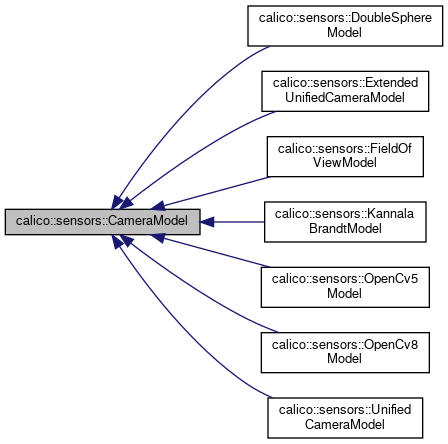
Inheritance diagram for calico::sensors::CameraModel:
Public Member Functions | |
| template<typename T > | |
| absl::StatusOr< Eigen::Vector2< T > > | ProjectPoint (const Eigen::VectorX< T > &intrinsics, const Eigen::Vector3< T > &point) const |
| template<typename T > | |
| absl::StatusOr< Eigen::Vector3< T > > | UnprojectPixel (const Eigen::VectorX< T > &intrinsics, const Eigen::Vector2< T > &pixel) const |
| virtual CameraIntrinsicsModel | GetType () const =0 |
| Getter for camera model type. | |
| virtual int | NumberOfParameters () const =0 |
| Getter for the number of parameters for this camera model. | |
Static Public Member Functions | |
| static std::unique_ptr< CameraModel > | Create (CameraIntrinsicsModel camera_model) |
Detailed Description
Base class for camera models.
Member Function Documentation
◆ Create()
|
static |
Factory method for creating a camera model with camera_model type. This method will return a nullptr if an unsupported CameraIntrinsicsModel is passed in.
◆ ProjectPoint()
template<typename T >
| absl::StatusOr< Eigen::Vector2< T > > calico::sensors::CameraModel::ProjectPoint | ( | const Eigen::VectorX< T > & | intrinsics, |
| const Eigen::Vector3< T > & | point | ||
| ) | const |
Project a point resolved in the camera frame into the pixel space. Top level call invokes the derived class's implementation.
◆ UnprojectPixel()
template<typename T >
| absl::StatusOr< Eigen::Vector3< T > > calico::sensors::CameraModel::UnprojectPixel | ( | const Eigen::VectorX< T > & | intrinsics, |
| const Eigen::Vector2< T > & | pixel | ||
| ) | const |
Inverts the projection model \(\mathbf{P}\) to obtain the bearing vector \(\mathbf{p}_m\) of the pixel location \(\mathbf{p}\). Multiplying the return quantity by the distance of the point gives the location of the resolved in the camera frame. Top level call invokes the derived class's implementation.
The documentation for this class was generated from the following files:
- calico/sensors/camera_models.h
- calico/sensors/camera_models.cpp