#include <camera_models.h>
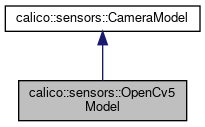
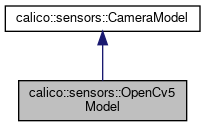
Public Member Functions | |
| OpenCv5Model & | operator= (const OpenCv5Model &)=default |
| CameraIntrinsicsModel | GetType () const final |
| Getter for camera model type. | |
| int | NumberOfParameters () const final |
| Getter for the number of parameters for this camera model. | |
 Public Member Functions inherited from calico::sensors::CameraModel Public Member Functions inherited from calico::sensors::CameraModel | |
| template<typename T > | |
| absl::StatusOr< Eigen::Vector2< T > > | ProjectPoint (const Eigen::VectorX< T > &intrinsics, const Eigen::Vector3< T > &point) const |
| template<typename T > | |
| absl::StatusOr< Eigen::Vector3< T > > | UnprojectPixel (const Eigen::VectorX< T > &intrinsics, const Eigen::Vector2< T > &pixel) const |
Static Public Member Functions | |
| template<typename T > | |
| static absl::StatusOr< Eigen::Vector2< T > > | ProjectPoint (const Eigen::VectorX< T > &intrinsics, const Eigen::Vector3< T > &point) |
| template<typename T > | |
| static absl::StatusOr< Eigen::Vector3< T > > | UnprojectPixel (const Eigen::VectorX< T > &intrinsics, const Eigen::Vector2< T > &pixel, int max_iterations=30) |
| Static Public Member Functions inherited from calico::sensors::CameraModel | |
| static std::unique_ptr< CameraModel > | Create (CameraIntrinsicsModel camera_model) |
Static Public Attributes | |
| static constexpr int | kNumberOfParameters = 8 |
| static constexpr CameraIntrinsicsModel | kModelType = CameraIntrinsicsModel::kOpenCv5 |
Detailed Description
5-parameter Brown-Conrady projection model as presented in OpenCV. This model assumes an isotropic pinhole model, i.e. \(fx == fy = f\).
Parameters are in the following order: \([f, c_x, c_y, k_1, k_2, p_1, p_2, k_3]\)
See the OpenCV documentations page for more details.
Member Function Documentation
◆ ProjectPoint()
|
inlinestatic |
Returns projection \(\mathbf{p}\), a 2-D pixel coordinate such that
\[ \mathbf{p} = \left[\begin{matrix}f&0\\0&f\end{matrix}\right]\mathbf{p}_d + \left[\begin{matrix}c_x\\c_y\end{matrix}\right]\\ \mathbf{p}_d = s\mathbf{p}_m + \left(2\mathbf{p}_m{\mathbf{p}_m}^T + r^2\mathbf{I}\right) \left[\begin{matrix}p_2\\p_1\end{matrix}\right]\\ s = 1 + k_1r^2 + k_2r^4 + k_3r^6\\ r^2 = {\mathbf{p}_m}^T\mathbf{p}_m\\ \mathbf{p}_m = \left[\begin{matrix}t_x / t_z\\t_y/t_z\end{matrix}\right]\\ \]
intrinsics is a vector of intrinsics parameters the following order: \([f, c_x, c_y, k_1, k_2, p_1, p_2, k_3]\)
point is the location of the feature resolved in the camera frame \(\mathbf{t}^s_{sx} = \left[\begin{matrix}t_x&t_y&t_z\end{matrix}\right]^T\).
◆ UnprojectPixel()
|
inlinestatic |
Inverts the projection model \(\mathbf{P}\) to obtain the bearing vector \(\mathbf{p}_m\) of the pixel location \(\mathbf{p}\). No closed form solution is available, so we use Newton's method to invert the projection model.
intrinsics is a vector of intrinsics parameters the following order: \([f, c_x, c_y, k_1, k_2, p_1, p_2, k_3]\)
max_iterations specifies the maximum number of Newton steps to take. Optimization will stop automatically if the error is less than 1e-14.
Note: This implementation produces superior results for high distortions compared to OpenCV's implementation. If your application requires numerical precision, it is recommend that you use this one.
The documentation for this class was generated from the following file:
- calico/sensors/camera_models.h